Department of Geography
University of California at Santa Barbara
ASSIGNMENT 2
1. Go to the United Nations Common Database (CBD) web page and download your country’s crude birth rate, crude death rate and total population data for the years 1950, 1960, 1970, 1980, 1990 and 2000. The specific codes for the tables areas follows:
- Population total, estimates and projections (code: 13660)
- Birth rate, crude (code: 13580)
- Death rate, crude (code: 13600)
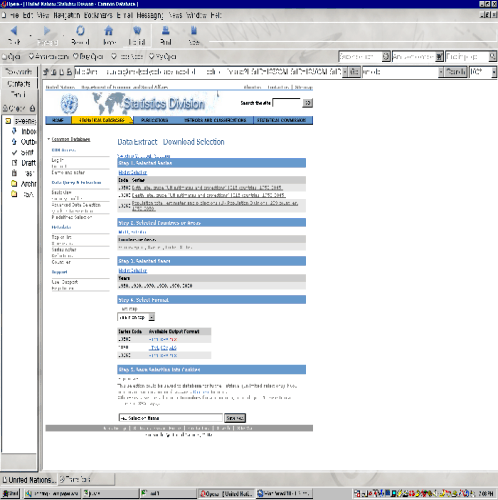
The url for the CDB is listed under the UN links on the G143 web page. The CBD user interface is shown below. Note that it is possible to select multiple series and multiple years for a single data extraction. I used the ‘Advanced Data Selection’ option.
2. Download the Excel spreadsheet associated with this assignment from the G143 web page. The spreadsheet has three worksheet tabs labeled “data”, “graphs”, “four variable model”, and “projection.” Go to the “graphs” worksheet and paste (or enter) your data from the UN site under the columns labeled crude birth rate, crude death rate, and population. The growth rate will be calculated by the spreadsheet, e.g. r=(CBR-CDR)/1000. Print the three line graphs and use them to answer the following questions.
- Is there a trend in CBR over years? What is it?
- Is there a trend in the CDR over year? What is it?
- What additional information do you think you would need to understand the trends in the CBR or CDR?
- How would you characterize the population growth trend? How is it reflected in time path of the growth rate? Are the population trend being driven by changes in the CBR or the CDR?
3. The spreadsheet also includes data for France, Spain, Sweden, and the U.S.A. - all countries that the U.N. classifies as ‘developed.’ Follow the same procedure as you did for question 2 but produce graphs for one or more of the four developed countries. How do the trends for the developed countries compare to your country?
4. Based on your contemplation of trends for your country carried out in questions 2 and 3, choose upper and lower bounds for the growth rate you expect to prevail over the future. Use the growth rates to calculate expected ‘high’ and ‘low’ population projections for the year 2050. Use the graph template under the ‘projections’ page to plot your expected high and low population projections.
- How long until your population doubles under the ‘high’ variant?
- How long until your population doubles under the ‘low’ variant?
- How close are your high and low growth rates compared to the implied average annual growth rate over the period 1950 to 2000?
5. Organize all of your work from this assignment into your three-ring binder. Write 2-3 pages about basic demographic forces and your expectations about future growth? Your discussion should refer to the graphs you created under question 2.